Meet the Southern leaf-tailed gecko
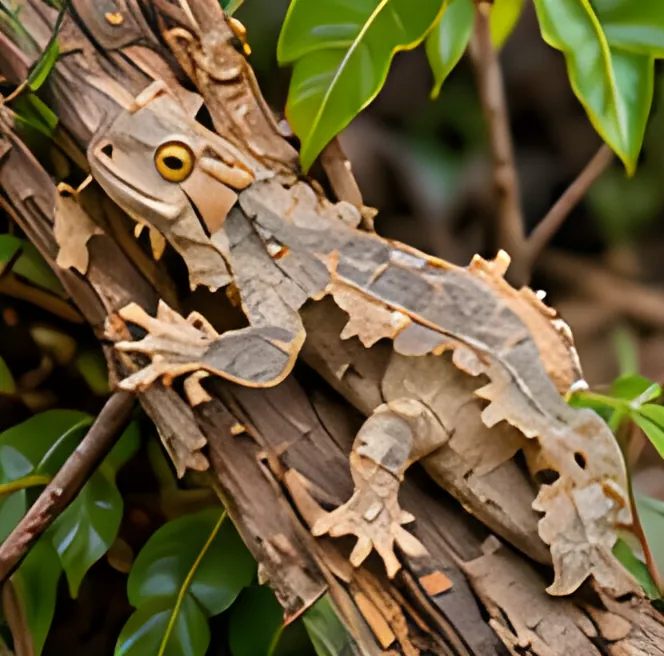
The southern leaf-tailed gecko is a master of camouflage. Its flattened body is covered in rough, pointed scales and mottled in grey and brown, so pressed against sandstone or bark it seems to disappear. Its broad, flat, leaf-shaped tail stores fat and works as a decoy: if grabbed, the gecko drops it and escapes, then grows a new, smoother tail.
It is a patient night-time ambush hunter, waiting on rock faces and tree trunks for spiders, cockroaches, beetles and moths. When cornered it rises up, opens its mouth wide, waves its tail and lunges with a raspy call.
This is a true Sydney local. It lives throughout the sandstone country of the Sydney Basin and often turns up in garages, retaining walls, woodpiles and houses. Females lay small clutches of one or two eggs in crevices.
It was among the first Australian lizards described by Europeans. George Shaw named it Lacerta platura in 1790 in John White's Journal of a Voyage to New South Wales. Its names are descriptive: Phyllurus means 'leaf tail' and platurus means 'broad tail'.
Where it lives
The Sydney Basin of New South Wales, from about Newcastle south to the Illawarra and west into the Blue Mountains, closely tied to Hawkesbury sandstone.
Keeper’s guide
Keeping a Southern leaf-tailed gecko
Why keepers love them
Leaf-tailed geckos are masters of camouflage: flat bodies and leaf-shaped tails let them vanish against sandstone and bark.
They are a classic Sydney-region gecko, and a well-built rock-and-bark backdrop shows them off beautifully.
A great match if you…
- You enjoy naturalistic display setups
- You have kept a gecko before
Think twice if you…
- Your home gets hot; they like cooler temperatures
Before you buy
- They prefer cool, stable temperatures and can struggle in hot summers.
- They are vertical climbers, so use a tall enclosure with lots of rock and bark.
- They are masters of hiding. You may not see your gecko for days, which is normal.
Setting up the enclosure
- Adult enclosure
- About 45 cm × 45 cm × 60 cm high.
- Heat
- About 24–28 °C during the day, cooler at night.
- Lighting
- A day–night cycle; low-level UVB is optional.
- Humidity
- Moderate, with light misting.
- Furnishings
- Vertical rock and bark surfaces to cling to.
Figures are typical starting points for adults. Measure temperatures with a thermometer at the surface the animal sits on, run every heat source through a thermostat, and adjust to how your animal behaves.
Feeding
Insects every second day, dusted with calcium.
Handling
Minimal handling; they drop tails if stressed.
Advanced keeper tips
- A textured rock backdrop doubles as a climbing surface and a hiding place.
- Lightly mist one side in the evening so they can drink droplets from rock surfaces.
- They respond well to a cooler winter, which is important for breeding.
Health watch-list
- Metabolic bone disease: soft jaw, shaky legs or kinked spine. Caused by too little UVB, calcium or heat. Prevent it with good UVB and supplements.
- Stuck shed on toes and tail tips can cut off circulation. Raise humidity and give a rough surface to rub on.
- Mouth rot (redness, swelling or cheesy material in the mouth): see a reptile vet.
- Parasites: get a faecal check after buying and whenever weight drops.
Find a reptile-experienced vet before you need one, and book a check-up soon after a new animal arrives.
Licences & the law
Kept under licence in several states. Check your state.
Check your state’s current list:QLDNSWVICSAWANTTASACT
Every native reptile and frog is protected. Never take one from the wild: buy captive-bred animals from a licensed keeper, keep the paperwork, and note that Tasmania does not allow mainland reptiles to be brought into the state.
Questions people ask
Are leaf-tailed geckos dangerous?
No. They are harmless to people; their gaping, lunging display is a bluff to scare off predators.
Where do broad-tailed geckos live?
They live in the Sydney Basin of New South Wales, mostly on sandstone outcrops, from about Newcastle to the Illawarra and into the Blue Mountains.
What should I do if I find a leaf-tailed gecko in my house?
Gently guide it into a container and release it outside nearby, close to rocks or a woodpile where it can hide.
Is the Southern leaf-tailed gecko a good pet for beginners?
Not really. We rate it "Intermediate": Best after you have kept an easier species for a year or two. They prefer cool, stable temperatures and can struggle in hot summers.
How long does the Southern leaf-tailed gecko live in captivity, and how big an enclosure does it need?
Plan for about 10–15 years in captivity. An adult needs a small enclosure of about 45 × 45 × 60 cm high.