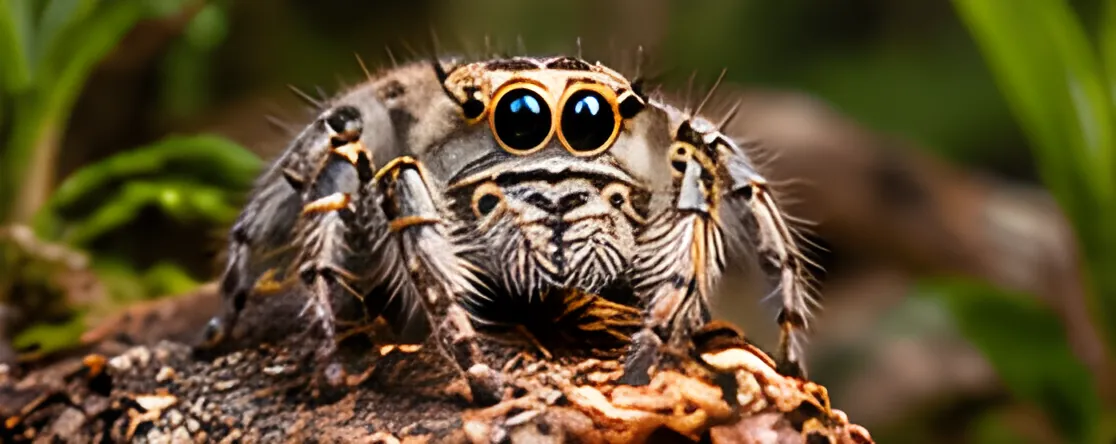
Jumping spider terrarium: tiny hunter, vertical little world.
Jumping spiders (Salticidae) are active visual hunters, often only a few millimetres long. Their appeal is obvious: big forward-facing eyes, deliberate stalking and a lot of personality packed into a tiny animal. Their enclosure design needs to respect that tiny scale.
FamilySalticidae
Australian rangeAustralia-wide
ActivityMostly diurnal visual hunters
Biggest design riskTiny escape gaps near doors and lids
01
1. Give them vertical surfaces and sight lines
The Australian Museum describes jumping spiders as daylight hunters that stalk prey using excellent vision. A useful terrarium therefore needs vertical climbing surfaces, small branches and open sight lines rather than a dense wall of clutter.
02
2. Protect the top retreat zone
Many jumpers build silk retreats high in the enclosure. If the door or lid opens through that zone every time you feed, you can repeatedly damage the spider’s chosen retreat. Side-opening access or a design that leaves the upper retreat corner undisturbed can be much easier to live with.
03
3. Escape-proof means spiderling-proof
Check ventilation holes, sliding-door overlap, magnetic door corners and the gap behind any removable backdrop. A custom panel should sit flush enough that the spider cannot disappear behind it unless that space is intentionally accessible.
04
4. Keep the micro backdrop thin
A narrow bark-style panel, tiny ledge or textured vertical strip can create a lot of usable surface without turning a small enclosure into a solid lump of scenery. For jumping spiders, detail is more valuable than thickness.
05
5. Feeding access should be calm and predictable
Plan one clear access point for introducing appropriately sized live prey and removing leftovers. You should not need to pull out half the hardscape to do routine feeding.
Where custom work can actually help
Small pieces. Specific jobs.
Micro bark panel
Thin textured rear or side panel for climbing and visual interest.
Web-anchor ledges
Very small high-level ledges or anchor points positioned away from the main door path.
Removable twig mounts
Tiny sockets for replacing natural twigs without disturbing the whole enclosure.
No. They are small animals, but the enclosure still needs enough usable vertical space, prey access and secure retreat areas for the particular species and life stage.
Should I handle a jumping spider?
Routine handling is unnecessary. A well-designed enclosure lets you feed, observe and maintain the habitat without relying on handling.
Can a jumping spider live in a reptile terrarium?
Sometimes, but many reptile enclosures have gaps or ventilation openings that are too large for small spiders. Check the actual smallest gap, not just the advertised enclosure size.
Have a tiny weird enclosure problem?
Good. Those are fun.
Send the species, enclosure photos and internal dimensions. We can work out whether a micro backdrop, hide, branch mount or one-off accessory would actually improve the habitat.